All industries
05 / 12

Manufacturing & Quality

Turning veteran know-how into a standard the line can follow

Visual inspection, assembly checks and equipment rounds on the shop floor still rely on experienced hands. The standard lives in people's heads and drifts with every shift change. We first write down the work and quality standards, then use vision, sound-and-vibration and language models at the line edge to check every part and every step, so the know-how stays in the process.
Where the process breaks

First, be clear about what goes wrong.

  1. 01

    Standards live in veterans’ heads

    Which scratch counts as a reject, which noise means a machine is in trouble: much of it rests on senior workers’ experience and little is written down. When they leave or the shift changes, judgement drifts.

  2. 02

    Misses reach the customer

    Appearance and assembly rely on sampling and line walks, and people tire after hours of watching. Defects slip to the next station or the customer, and by the time anyone traces them the batch is hard to pin down.

  3. 03

    Records are ticks and hearsay

    Inspection sheets, handover books and quality notes are mostly ticks or a few words, with symptoms and causes left out. The same problems keep coming back, but no one can group them to find the root cause.

Process map

First see how work flows in this industry, then mark where AI can step in.

05Production & Quality
01Process Prep
  • Process document Q&A
  • Work instruction version checks
  • Onboarding Q&A
02Incoming Inspection
  • Visual incoming material check
  • Inspection sheet capture
  • Supplier issue filing
03Assembly
  • Inline defect detection
  • Missed or wrong-order step alerts
  • First-article comparison
04Maintenance
  • Abnormal sound and vibration alerts
  • Voice-logged repair records
  • Spare parts demand forecast
05Quality & Complaints
  • Voice shift handovers
  • Root-cause grouping
  • Similar complaint search
01

Inline Visual Defect Detection

VisionEdge

The problemInspectors stand by the line checking scratches, short shots and colour variation by eye. After hours of staring, defects slip through, and each shift draws the pass/fail line a little differently.

BeforeAfter
01Inspector checks parts by eye
01Line cameras inspect every part
02Pass or fail judged from experience
02Judged against one defect library
03Fatigue lets defects slip through
03Every part checked the same way
04Defects found at the next station
04Rejects pulled at the station

How it runs on site

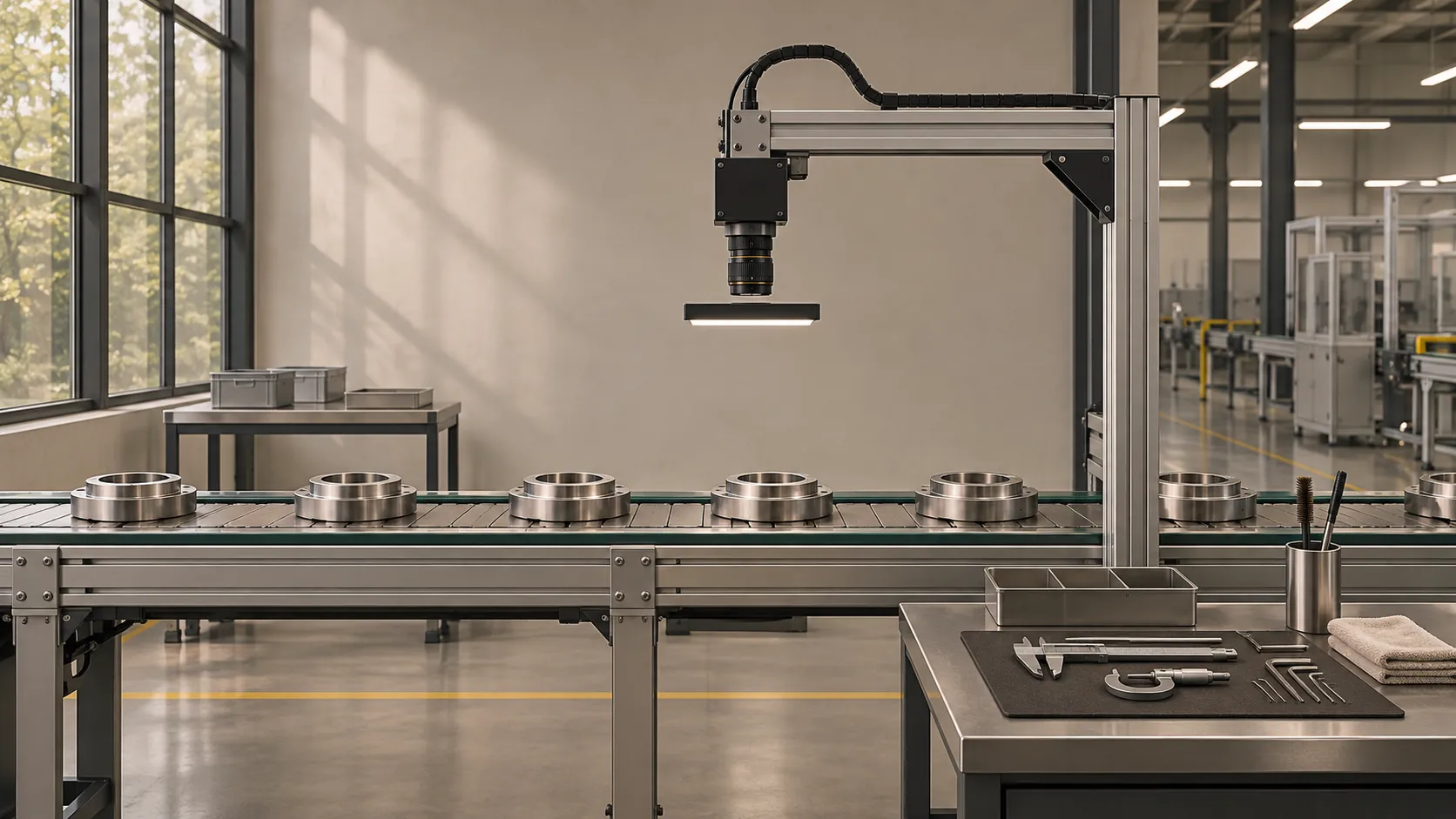
At the start of the morning shift, the inspector runs a few known good and bad parts past the camera to confirm it is judging correctly. Once the line starts, every part is photographed and the edge box decides on the spot: clear rejects are pushed to the reject chute, borderline ones get a yellow light and go to a review bin. The inspector clears the bin at intervals, enters each verdict, and those images are added to the sample library after the shift.

How it is done

  1. 01Build a defect list with the quality team: which defects matter, how large is too large, and which can be reworked.
  2. 02Collect images of good and defective parts by defect type and have senior inspectors label them into a reference library.
  3. 03Fit industrial cameras and an edge computer at the station so the vision model decides locally, without relying on the network or slowing takt time.
  4. 04Uncertain parts go to an inspector and the verdicts are added to the library. New products or tool changes get fresh samples before going live.

What changes

  • From sampling to checking every part
  • Same pass/fail line on every shift
  • Every defect traceable with an image

Who does what

  • InspectorRe-checks parts in the review bin, records verdicts and adds samples of new defect types.
  • Quality engineerReviews misses and false rejects, confirms sample labels and adjusts the criteria.
  • Production managerLooks at defect patterns by shift and decides which steps to improve or bring into inspection.

What you need

  • Industrial camera and lighting
  • Good parts and each defect type
  • Current defect list and criteria
  • Reject chute or review bin

What it will not do

  • Judges visible appearance only, not internal performance or precise dimensions.
  • After a new product or tool change, people inspect everything until samples catch up.
02

Assembly Step Verification

VisionEdge

The problemAssembly steps are written in the work instruction, but following them depends on the operator and the occasional supervisor walk-by. A missing screw, a reversed washer or steps out of order often show up only at final inspection, or at the customer.

BeforeAfter
01Work instruction posted at the station
01Instruction split into checkable steps
02Operator assembles from memory
02Camera confirms each step in order
03Supervisor checks now and then
03Missed or out-of-order steps flagged instantly
04Missed steps found at final inspection
04Each unit keeps an assembly record

How it runs on site

An assembler sets a housing on the station and the camera follows each step in the work instruction: part in place, washer the right way round, every screw fitted. Miss a screw and the station screen flags it at once; the next step can only be scanned once it is fixed. On line walks the team lead no longer checks every unit, just the prompt log. When the unit is done, its step record is filed with the serial number for final inspection to pull up if needed.

How it is done

  1. 01Go through each station's work instruction and define what is fitted at each step, in what order, and what a finished step looks like.
  2. 02Photograph each completion sign, such as screws seated, parts in place or a barcode scanned, and set the rules for judging them.
  3. 03Deploy the vision model on an edge device at the station. It watches the workpiece, parts and tools only, never faces.
  4. 04Prompts are for on-the-spot correction, not performance scoring. Whenever the process changes, the steps and samples are updated with it.

What changes

  • Missed steps caught at the station
  • Every unit has an assembly record
  • New operators work to the same standard

Who does what

  • AssemblerCompletes any missed step the screen points out and flags false alarms with one tap.
  • Team leadReviews prompts and false alarms, coaches on the line and confirms misjudged samples.
  • Process leadUpdates steps and samples when the process changes and decides which stations to add.

What you need

  • Work instructions for each station
  • Photos of each step done right
  • Station camera and edge device
  • Serial numbers or scan records

What it will not do

  • Sees parts and tools only; no face recognition, never used for piece-rate pay.
  • Invisible steps such as torque still rely on tightening tools and final inspection.
03

Sound and Vibration Early Warning

ForecastingEdge

The problemMachine health is judged by a technician listening and feeling for heat on rounds, and the checklist is mostly ticks. Growing noise or vibration goes unnoticed until the machine stops and needs an emergency fix.

BeforeAfter
01Scheduled rounds with a checklist
01Sensors record sound and vibration continuously
02Technician listens for odd noises
02Model compares against normal running
03Checklist reduced to ticking boxes
03Alerts sent as trends worsen
04Emergency repair after breakdown
04Repairs planned from alerts

How it runs on site

On the night shift only a few maintenance staff are on site, while sensors keep recording sound and vibration from the main motors. The edge gateway notices one machine vibrating more than usual, and the trend getting worse, so it alerts the maintenance lead with a trend chart. The lead goes over, listens and feels the bearing temperature, confirms something is off, and books it into the next day’s planned maintenance instead of letting it stop mid-shift.

How it is done

  1. 01Review the critical equipment list, failure history and current checks, and start with the machines whose downtime hurts most.
  2. 02Add vibration and acoustic sensors, record normal running, and label data from before and after known failures.
  3. 03An edge gateway analyses signals on site while a time-series model learns each machine's normal range; only alerts and summaries leave the plant.
  4. 04Maintenance staff confirm each alert and log what they found, which tunes the thresholds before rolling out to more machines.

What changes

  • From fixing breakdowns to planned repairs
  • Problems backed by data, not hunches
  • Veteran know-how captured as rules

Who does what

  • Equipment checkerGoes to the machine when alerted and records what they find against the checklist.
  • Maintenance leadConfirms whether alerts are real, schedules planned repairs and logs the outcome.
  • Maintenance managerReviews alerts and downtime, adjusts thresholds and picks the next machines to connect.

What you need

  • Critical machines and fault history
  • Vibration and sound sensors
  • Data from normal operation
  • Current checklists and repair logs

What it will not do

  • Flags trends only; it never stops machines or decides on part replacement.
  • New machines need a period of normal-running data before alerts are useful.
04

Voice Logs for Handovers and Quality

SpeechLanguage

The problemShift handovers are verbal or scribbled in a notebook, and quality issues get a line or two at best. Finding a cause means flipping pages and tracking down whoever was on shift, and repeat problems never get grouped together.

BeforeAfter
01Handovers spoken or handwritten
01Speak into a phone, get a written log
02Quality issues noted in a few words
02Sorted into symptom, cause and action
03Causes traced by asking around
03Records searchable by keyword
04Similar issues logged separately
04Similar issues grouped automatically

How it runs on site

At handover, the outgoing team lead talks into a phone: which machine had a tool change, which step had a batch reworked, what is still open. The model turns it into symptom, cause, action and open items, and the incoming lead reads, corrects and confirms it. A few days later the same step shows a similar problem; the quality engineer types a keyword and pulls up the earlier records and related complaints together.

How it is done

  1. 01Agree the required fields for handovers and quality records: machine, operation, symptom, action taken and open items.
  2. 02Compile shop-floor terms, machine names and part numbers into a glossary so speech recognition understands how people actually talk.
  3. 03A speech model transcribes and a language model structures and groups the notes; process documents and complaints join the same searchable Q&A.
  4. 04Records are saved only after the team lead confirms them, and the quality team reviews the groupings weekly to fix categories and the glossary.

What changes

  • Handover items no longer lost in conversation
  • Quality issues traced by category
  • Process files and complaints found by asking

Who does what

  • Shift leadSpeaks the handover points, checks the record the model prepares and confirms it.
  • Quality engineerReviews groupings weekly, fixes categories and vocabulary, and chases repeat problems.
  • Workshop managerReviews open items and repeat issues, assigns owners and plans improvements.

What you need

  • Handover and quality templates
  • Shop-floor terms and part numbers
  • Process documents and complaints
  • Team lead phones or terminals

What it will not do

  • Records and organises only; root-cause conclusions stay with quality staff.
  • Very noisy areas reduce accuracy; typing can fill the gaps.

Where to start

Start with visual inspection at one station that produces many appearance defects and complaints. Real reject parts are on hand for samples, the standard can be agreed with the quality team, results show up immediately, and uncertain parts go to a person, so shipments are not affected. Leave whole-line upgrades and automatic process tuning for later; they touch too much and carry more risk.

Common questions

What owners and floor managers ask most.

Do we need new lines or machines?

Usually not. Visual inspection adds a camera and an edge box to an existing station, and early warning adds sensors to the outside of existing machines, without modifying them. Very fast or cramped stations need a site check first to confirm the camera fits and sees clearly; some need new lighting or fixtures.

Does shop-floor footage leave the plant?

Inline inspection and assembly checks run on edge devices in the workshop, so images stay in the plant and only results and reject photos are kept. Voice logs and document search can run in the cloud or on an in-plant server; for sensitive process documents we recommend keeping them in-house.

Will workers feel watched?

Cameras look only at parts, components and tool positions, with no face recognition, and prompts are for on-the-spot correction, never attendance or piece-rate pay. Explain these rules to the team beforehand and involve team leads in setting standards. Some unease at first is normal; trust takes time.

When is this not worth doing?

If batches are tiny and almost every order is different, there are never enough samples and visual inspection will not be stable. If quality and production still disagree on what a defect is, settle the standard first. In those cases, start with voice records and search instead.

Your situation

What is your pain point?

Every business runs differently. The solutions above are only the common patterns in this industry. Tell us the one step that hurts most and we will look at your actual case, starting with whether AI is the right fit.

Email us directlyhao@wallingtech.cn
We only use what you submit to reply to this enquiry.